







How many calories does 1 hour of swimming burn – What parents should know
Many parents are amazed to hear that a preschooler can burn up to 400 calories per hour while swimming. Especially those aiming for a swimming badge often wonder how much energy is actually expended during training. Understanding how much swimming style, technique, and physique influence calorie consumption can help parents specifically contribute to their child's fitness and safety and get the most out of each swimming session.
Table of Contents
- What Does Calorie Consumption Mean in Swimming?
- Influence of Swimming Style and Pace on Calories
- How Age, Weight, and Height Change Consumption
- Comparison: Swimming Versus Other Children's Sports
- How Parents Can Best Support Swimming Training
Key Findings
| Point | Details |
|---|---|
| Calorie Consumption in Swimming | Calorie consumption depends on factors such as body weight, swimming technique, and intensity. Different swimming styles lead to varying calorie consumption and muscle group activation. |
| Influence of Age and Body Weight | Calorie consumption changes with age and body weight. Children with more muscle mass burn calories more efficiently. |
| Swimming Versus Other Sports | Swimming burns more calories than many other children's sports and is gentle on the joints. It offers holistic physical training for children. |
| Parental Support | Parents should actively support swimming training, pay attention to nutrition and recovery, and create a positive atmosphere. Encouraging communication with instructors is also crucial. |
What Does Calorie Consumption Mean in Swimming?
Calorie consumption in swimming describes the amount of energy the body uses during swimming. It is a complex physiological calculation that depends on various individual factors. Performance metabolism in swimming includes more than just basal metabolism.
In swimming, several aspects play a crucial role in energy consumption: body weight, swimming technique, intensity, and water temperature influence how many calories are actually burned. For example, a child weighing 25 kilograms burns about 300-400 calories per hour doing breaststroke, while a teenager weighing 50 kilograms can burn up to 500-600 calories.
The special feature of swimming lies in its full-body workout. Unlike many sports, almost all muscle groups are activated simultaneously. Effective calorie burning results from the combination of strength, endurance, and technique. The better the swimming technique, the more efficiently the body works and the more targeted calories are burned.
Pro-Tip: Encourage your child to learn different swimming styles to optimally increase calorie consumption and physical fitness.
Influence of Swimming Style and Pace on Calories
Different swimming styles have a significant impact on calorie consumption. Different swimming styles utilize various muscle groups and lead to different energy costs. Butterfly stroke, for instance, is extremely physically demanding and burns significantly more calories than the more leisurely breaststroke.
Pace also plays a crucial role in calorie balance. Calorie consumption in swimming varies significantly depending on the intensity of movement. A child swimming slowly and relaxed will consume considerably less energy than one gliding through the water at high speed and with precise technique. Front crawl is considered a particularly efficient swimming technique that activates large muscle groups simultaneously.
For parents, it's important to know that not only swimming style but also individual factors such as body weight, age, and general fitness influence calorie consumption. A 10-year-old child will burn calories differently while swimming than a teenager or adult. Improving swimming technique therefore means not only swimming better but also consuming energy more effectively.
Pro-Tip: Encourage your child to learn different swimming styles and vary their pace to optimize training efficiency and calorie consumption.
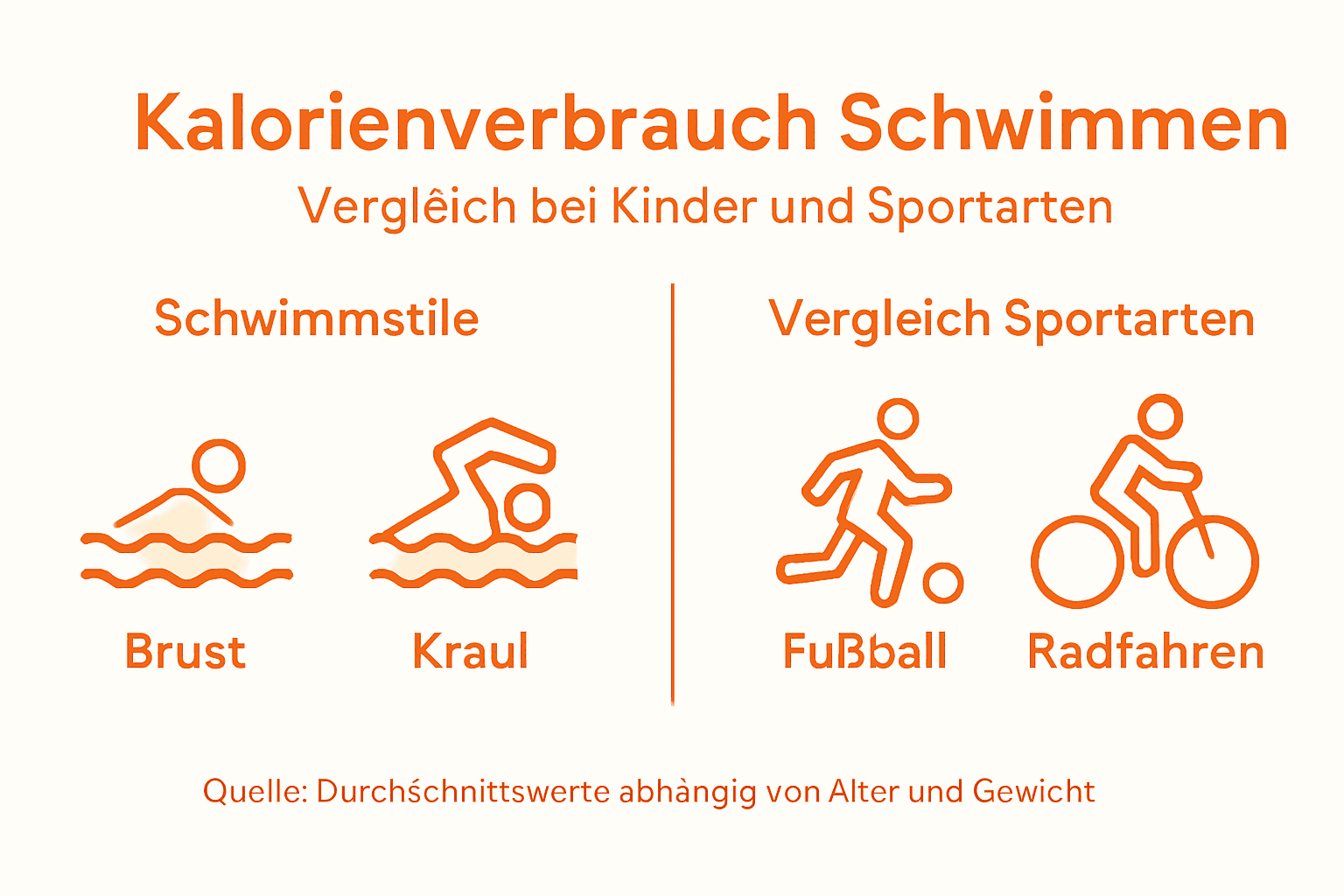
Below is an overview of how different swimming styles influence calorie consumption and muscle groups:
| Swimming Style | Calorie Consumption (per hour, child) | Main Muscle Groups Used |
|---|---|---|
| Breaststroke | 300–400 | Legs, chest, arms |
| Front Crawl | 400–600 | Back, shoulders, core |
| Backstroke | 350–450 | Back, legs, arms |
| Butterfly | 500–700 | Shoulders, chest, abdomen |
How Age, Weight, and Height Change Consumption
Calorie consumption during swimming is not a static figure; rather, it is dynamically influenced by various physical parameters. Anthropometric characteristics such as height play a crucial role in energy expenditure. The taller and heavier a child is, the more calories are burned during swimming, as more body mass needs to be moved.
As we age, our metabolism changes fundamentally. Basal metabolic rate decreases continuously, meaning that children burn different amounts of calories at various developmental stages. For example, a preschooler will swim and consume energy differently than a teenager. Body composition, muscle development, and coordination skills directly influence calorie consumption.
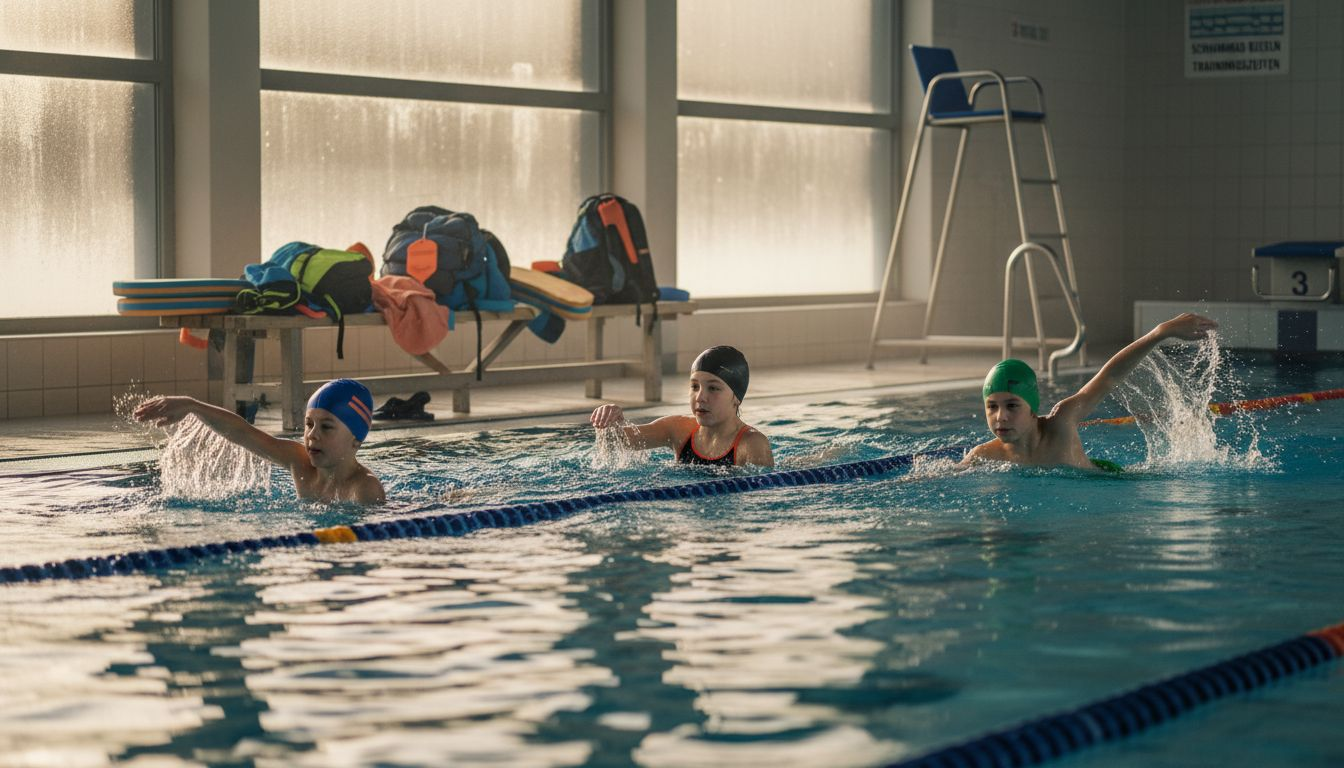
It is particularly interesting that not only weight but also body composition plays an important role. Muscle mass burns more calories than fat tissue, so physically active children with well-developed musculature can swim more effectively and expend more energy. This explains why regular swimming training not only makes one fit but also positively influences basal metabolic rate.
Pro-Tip: Document your child's swimming development to track individual progress in terms of performance and calorie consumption.
Comparison: Swimming Versus Other Children's Sports
Swimming stands out from other children's sports due to its unique health benefits. Health benefits of swimming extend far beyond mere calorie burning. Unlike sports such as football or basketball, swimming places minimal stress on the joints, thus enabling a gentle, holistic physical workout for children of varying fitness and health levels.
In terms of calorie burning, swimming performs particularly impressively. Calorie consumption in comparison shows that swimming burns significantly more calories per hour than many other children's sports. While a child playing football burns about 300-400 calories per hour, swimming can achieve up to 500-700 calories per hour – depending on the swimming style and intensity.
Another crucial advantage of swimming is the full-body workout. In contrast to sports that train only individual muscle groups, swimming activates almost all muscle groups simultaneously. This makes swimming an extremely efficient sport for children who want to promote strength, endurance, and coordination equally. The combination of strength training and endurance sports in the water is unique and cannot be achieved in this form by any other sport.
Pro-Tip: Encourage your child to learn different swimming styles to make optimal use of the diverse health benefits.
Here's a comparison: calorie consumption and benefits of popular children's sports at a glance:
| Sport | Calorie Consumption (per hour, child) | Main Benefits for Children |
|---|---|---|
| Swimming | 500–700 | Full-body workout, gentle on joints |
| Football | 300–400 | Team spirit, endurance, leg strength |
| Basketball | 350–450 | Coordination, speed |
| Cycling | 250–400 | Cardiovascular, leg muscles |
How Parents Can Best Support Swimming Training
Supporting children in swim training requires more than just presence. Creating safe swimming environments means actively promoting the quality of training and the child's safety. Parents should not only monitor training times but also closely observe the development of their child's swimming technique and self-confidence.
A balanced diet and adequate regeneration are crucial for training success. Medical aspects of swimming require a holistic view. Ensure adequate fluid intake, protein-rich meals before and after training, and sufficient sleep to support muscle regeneration. Communication with swimming instructors about health status and any physical limitations is also important.
Mental support plays at least as important a role as physical preparation. Motivate your child, be patient, and create a positive atmosphere around swimming. Do not set excessive expectations, but celebrate small successes. Avoid performance pressure and instead focus on fostering joy and enthusiasm for the sport.
Pro-Tip: Keep a small swimming diary where you document progress, feelings, and special moments together with your child.
Effectively Support Calorie Consumption in Swimming with Pimpertz
Swimming is one of the best sports for children to stay healthy and fit. Factors such as swimming style, pace, age, and body weight play an important role in calorie consumption and physical development. For parents, it is often a challenge to make this progress visible and to further motivate the child. This is where high-quality swimming badges and the diverse accessories from Pimpertz come in. With original certified certificates and child-friendly designs, you sustainably promote your children's motivation and strengthen their confidence in the water.
Benefit from over 38 years of experience, official partnership with DLRG and BFS, and lightning-fast shipping. Discover personalized badge kits and practical gift sets to playfully support swimming training. Turn swimming into a visible success and celebrate every step towards better technique and higher calorie consumption together.
Start now at pimpertz.de and secure the best swimming badges and accessories for your children. Turn every swimming session into an occasion for pride and promote your child's long-term health and fitness with Pimpertz. Learn more and order in no time at Pimpertz – your German partner for swimming badges and accessories.
Frequently Asked Questions
How many calories does a child burn swimming for one hour?
Calorie consumption depends on the swimming style and body weight. A child weighing 25 kg can burn about 300-400 calories doing breaststroke, while a 50 kg child can burn up to 500-600 calories.
Which swimming style burns the most calories?
The butterfly stroke burns the most calories, followed by freestyle. Breaststroke and backstroke consume less energy in comparison.
How do body weight and age affect calorie consumption during swimming?
Body weight has a direct impact on calorie consumption. Larger and heavier children burn more calories. Age also plays a role: older children have a faster metabolism and burn calories differently.
What are the advantages of swimming compared to other sports for children?
Swimming is gentle on the joints and activates almost all muscle groups. Compared to sports like football, you burn more calories per hour and simultaneously promote endurance, strength, and coordination.