



Teaching children breaststroke: The safe way
More than 60 percent of children in Germany feel insecure during their first attempt at swimming. For parents, the exciting task now begins of making the introduction to breaststroke as stress-free and successful as possible. A well-prepared bathing environment and suitable swimming equipment can make all the difference and help playfully strengthen your child's confidence. Here you will learn how to proceed systematically and gradually pave the way to safe breaststroke.
Table of Contents
- Step 1: Preparing Swimming Equipment and Bathing Environment
- Step 2: Explaining and Practicing the Correct Body Posture
- Step 3: Introducing Leg Movement on Land and in Water
- Step 4: Combining Arm and Leg Movements in Water
- Step 5: Reviewing and Consolidating Breaststroke Technique
Brief Summary
| Important Point | Explanation |
|---|---|
| 1. Safe Preparation of the Environment | Ensure safe bathing conditions and suitable swimming aids for your child. |
| 2. Explain Optimal Body Posture | Playfully teach your child the correct body position for breaststroke. |
| 3. Practice Frog Kick on Land | Have your child perform the leg movement on dry land to learn coordination. |
| 4. Combination of Arm and Leg Movements | Practice coordinating arm and leg movements with your child in the water. |
| 5. Review and Consolidate Technique | Provide targeted feedback on swimming errors and regularly practice partial movements. |
Step 1: Preparing Swimming Equipment and Bathing Environment
The first step to successful breaststroke with children is careful preparation of the swimming equipment and bathing environment. The goal is to create a safe and trusting atmosphere where your child feels comfortable and secure.
Start with the right swimwear. Choose a well-fitting swimsuit or swim shorts that allow freedom of movement and do not slip. In addition, the German Swimming Federation recommends playful water familiarization with child-friendly swimming aids. Choose swimming aids such as kickboards or swim belts that give your child security, but do not serve as permanent support.
The bathing environment should be absolutely safe. Choose a pool or an area with shallow water, constant water temperature, and non-slip surfaces. Always maintain direct visual contact and be ready to help your child immediately. Avoid crowded swimming areas and choose times with fewer people.
Pro Tip: Bring familiar toys to make water familiarization playful and positive.
Here is an overview of how different swimming aids provide support:
| Aid | Function | Recommended Age |
|---|---|---|
| Kickboard | Promotes leg coordination | Approx. 4 years and up |
| Swim Belt | Provides security, promotes freedom | 3 to 7 years |
| Noodle | Supports water familiarization | 3 years and up |
| Flotation devices (arms) | Provides buoyancy, restricts movement | 3 to 6 years |
Step 2: Explaining and Practicing the Correct Body Posture
In this step, the focus is on teaching your child the basic body posture for breaststroke. Optimal body position is crucial for efficient and safe swimming.
With the correct body posture in the water, the body lies flat and stretched on the water surface. Explain to your child that they should glide like a long rocket on the water. The face points slightly down into the water, while the legs are extended and together. The arms are held close to the body to minimize water resistance.
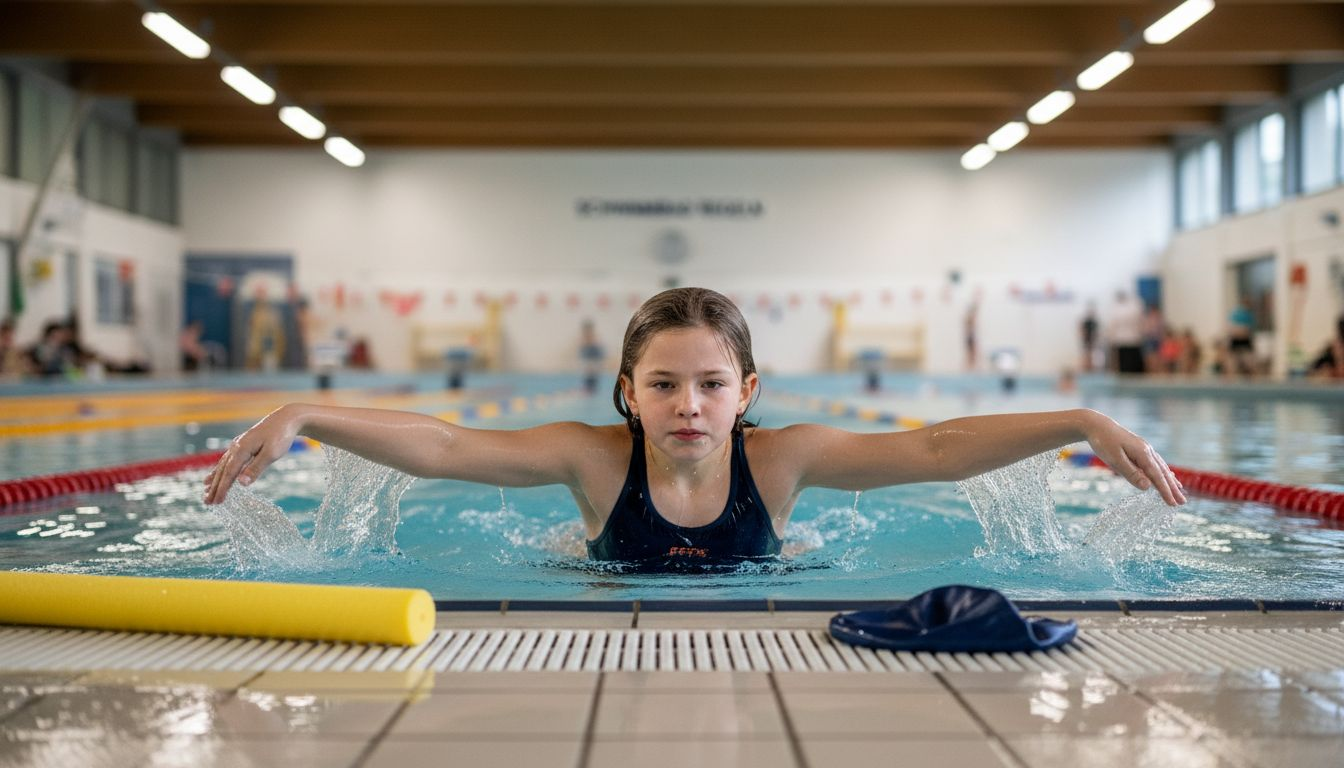
Start with simple exercises at the pool's edge. First, have your child push off the edge of the pool and try to glide as flat and long as possible. Pay attention to an extended body posture with straight legs and the head slightly lowered. It is important that the child exhales rhythmically and does not tense up.
Pro Tip: Use playful comparisons such as "Glide like a smooth penguin" or "Be as long as a canoe" to vividly convey the correct body posture.
Step 3: Introducing Leg Movement on Land and in Water
In this section, you will learn how to teach your child the basic leg movement for breaststroke. The frog kick is crucial for effective propulsion in the water.
Start with exercises for leg coordination first on land. Have your child lie on their back or stomach and perform the leg movement like a frog. It is important that the legs remain straight and the feet are turned outwards. Explain that the feet should act like paddles that push water backward.
In the water, practice the movement first with aids such as a kickboard or a swim noodle. Initially, hold your child under the arms and let them perform the frog kick. Make sure they breathe rhythmically and relaxed. The legs should be spread wide enough to effectively push water back, but not so wide that the child loses power.
Pro Tip: Turn the exercises into a game with funny frog noises or a competition to see who can glide the furthest.
Step 4: Combining Arm and Leg Movements in Water
After your child has learned the arm and leg movements individually, the challenge of coordination now begins. The goal is to combine arm and leg movements into a harmonious swimming rhythm.
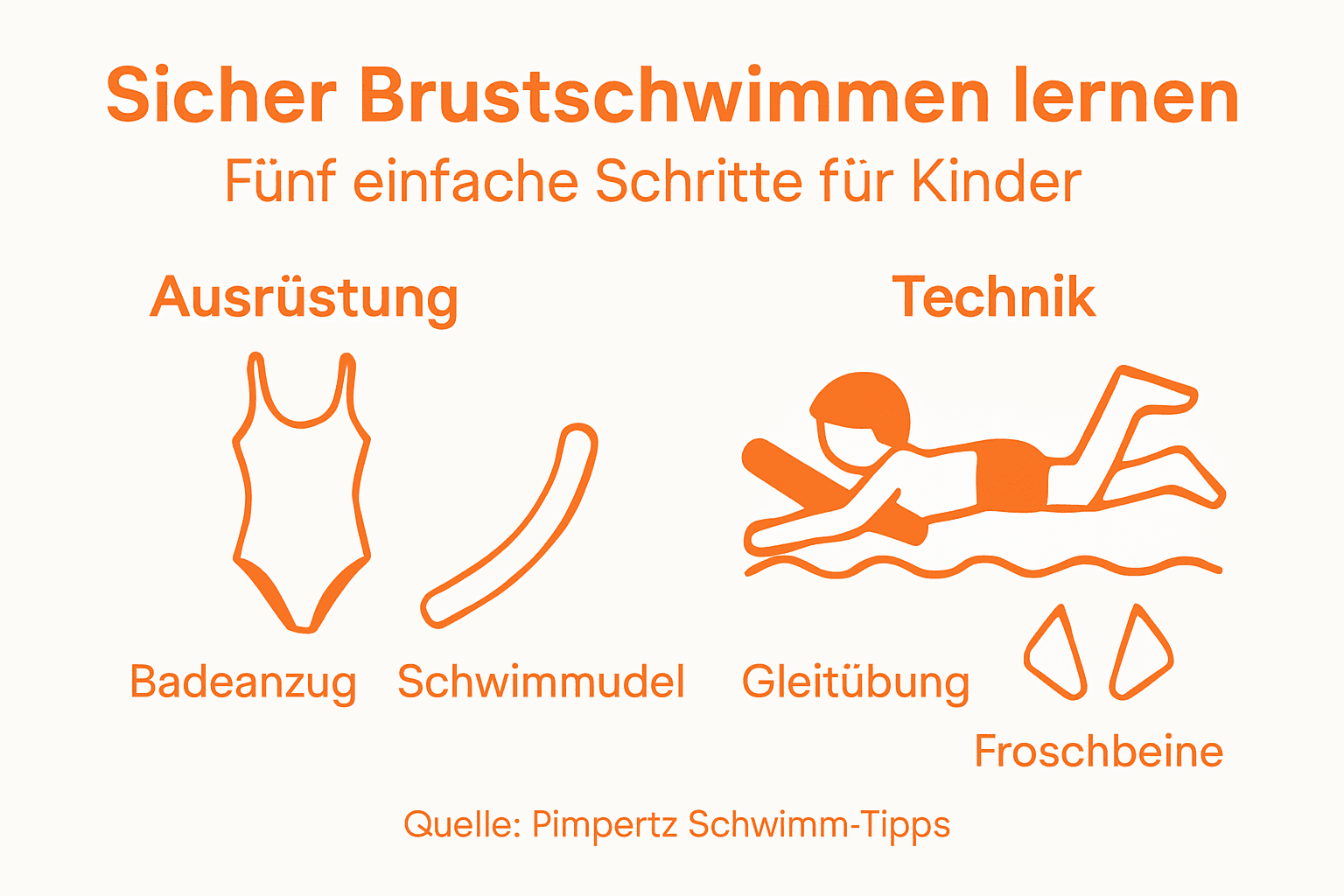
Coordination of arm and leg movements requires patience and gradual practice. First, have your child perform the arm movement in front of the body in a circular motion. At the same time, the legs perform the frog kick. The breathing rhythm is crucial: after each arm stroke, the head is briefly lifted out of the water to breathe.
Start with short practice sessions and slowly increase the complexity. Initially, hold your child under the arms and perform the movements together. Over time, they will internalize the coordination and swim more independently. Pay attention to relaxed breathing and avoid tension.
Pro Tip: Use swim noodles or kickboards as aids to playfully practice coordination and give the child security.
Step 5: Reviewing and Consolidating Breaststroke Technique
After the first swimming exercises, the important phase of refining the technique begins. The goal is to consolidate the learned movements and specifically correct small errors.
According to recommendations from the German Swimming Federation, exercises should be systematic and designed without fear. Pay attention to individual movement elements such as arm pull, leg kick, and breathing rhythm. Practice short partial sequences and give your child positive feedback. Take your time for repetitions and let the child feel the movements themselves.
Effective training includes targeted practice of partial movements and observation of the overall technique. Take video recordings or have an experienced swim coach accompany your child. Focus on a relaxed body posture and a consistent rhythm.
Pro Tip: Use playful exercises such as small competitions or obstacle games to maintain motivation and enjoyment of swimming.
Comparison of common breaststroke technique errors and their correction approaches:
| Error Pattern | Typical Cause | Correction Tip |
|---|---|---|
| Head too high in the water | Fear of water | Playfully practice diving |
| Legs too close together | Lack of leg coordination | Practice frog kick on land |
| Strained breathing | Insecurity | Practice breathing separately while standing |
| Asymmetrical arm pull | Lack of practice | Repeat arm movement individually |
Learn Breaststroke Safely and Motivated with Pimpertz
Learning the correct breaststroke with children is a challenge that requires a lot of patience and appropriate support. In your article, you have described important steps such as the safe preparation of swimming equipment, correct body posture, and coordinated arm and leg movements. The focus is primarily on safety and motivation so that children lose their fear of water and playfully gain confidence.
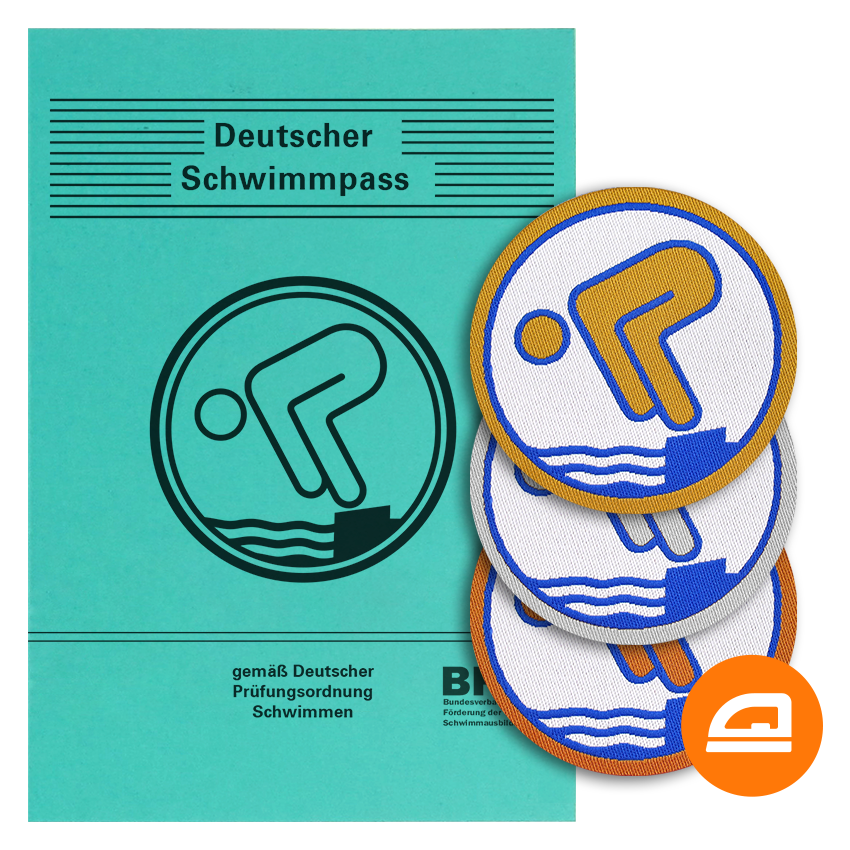
This is exactly where Pimpertz comes in as your experienced partner for swimming badges and accessories. Our high-quality swimming badges and child-friendly certificates not only give your child a visible moment of success after each learning experience, but also promote the joy of swimming. With our accessories specially developed for swimming courses, such as waterproof cases and collector's albums, we support parents and swimming instructors in systematically consolidating swimming techniques. Discover our attractive range and personalized bundle offers for even more motivation and safety when learning to swim.
Start your next swimming lesson with Pimpertz now and rely on quality, trust, and fast delivery. Visit us at pimpertz.de and find out how you can playfully guide your children to breaststroke with official swimming badges and suitable accessories. Convince yourself of our service and ensure your children the best support on the way to safe swimming success.
Frequently Asked Questions
How do I best prepare my child for breaststroke?
To best prepare your child for breaststroke, you should first choose the right swimming equipment and a safe bathing environment. Make sure to use swimming aids such as kickboards or swim belts and create a trusting atmosphere where your child feels comfortable.
What exercises help convey the correct body posture for breaststroke?
To promote correct body posture, you can perform simple gliding exercises at the edge of the pool. Have your child push off the edge of the pool and make sure they glide like a long rocket in the water.
How can I teach my child the leg movement for breaststroke?
Start with exercises for leg coordination on land, having your child perform the leg movement like a frog. Then practice in the water with support, for example under the arms, so they can perform the frog kick efficiently.
What is the best way to combine arm and leg movements?
To combine arm and leg movements, first practice the arm movement in a circular motion in front of the body, while the legs perform the frog kick. Make sure your child briefly lifts their head out of the water to breathe after each arm stroke.
How can I check and improve my child's breaststroke technique?
Check your child's technique by practicing short partial sequences and providing targeted feedback. Use playful exercises and competitions to increase motivation and promote a relaxed body posture.
What common mistakes should be avoided when swimming breaststroke?
Avoid common mistakes such as a head too high in the water or tense breathing. Focus on practicing breathing and movements separately, as well as on a relaxed posture, to improve swimming technique.


